

Something has fundamentally shifted in the way cybercriminals operate, and most organizations haven’t fully caught up.
For years, the conventional wisdom around cybersecurity centered on building stronger walls — better firewalls, tighter perimeters, more robust endpoint protection. But today’s attackers aren’t breaking down your walls. They’re walking through the front door using your own credentials. According to the 2024 Verizon Data Breach Investigations Report, over 74% of all breaches involve the human element, including stolen credentials, privilege abuse, and social engineering. The perimeter isn’t gone — it’s just moved. And it now lives inside your identity infrastructure.
The Attacker Has Already Changed. Has Your Defense?
Modern attackers are patient, methodical, and remarkably good at looking like legitimate users. They steal credentials through phishing, purchase them on the dark web, or exploit weak authentication to gain initial access. Once inside, they don’t announce themselves. They move quietly — escalating privileges, abusing service accounts, pivoting through cloud environments — all while blending seamlessly into normal business operations. By the time a traditional security tool flags something suspicious, the attacker has often been inside your environment for days, sometimes weeks. IBM’s Cost of a Data Breach Report consistently places the average breach identification time at over 200 days — a window large enough to cause catastrophic damage long before any alarm sounds.
It’s one of the core reasons XeneX built its entire SOC model around identity-first detection. Waiting for malware execution to trigger an alert is, in most modern attacks, already too late. The attack doesn’t start with malware. It starts with a login.
Why Traditional Security Operations Are Losing the Battle
The reason traditional security operations centers struggle with modern threats isn’t a lack of effort — it’s a structural problem. Most legacy SOC approaches analyze alerts in isolation. An unusual login here. Suspicious PowerShell activity there. Abnormal cloud API calls somewhere else. Each event gets triaged independently, generating an overwhelming volume of alerts that exhaust analysts and bury the signals that actually matter.
The numbers are staggering. Research from ESG found that security teams receive an average of 4,484 alerts per day, and nearly half go uninvestigated. That’s not a workflow problem — it’s a systemic failure in how traditional security tools were designed. They were built for a world where the perimeter was clear, threats came from outside, and malware was the primary weapon. That world no longer exists. Attackers have adapted. The tools protecting most organizations largely haven’t.
The result is alert fatigue, slower response times, and a dangerous gap between detection and action that sophisticated attackers know exactly how to exploit.
Context Is Everything — And Most Tools Don’t Have It
What’s needed is a fundamentally different approach — one built around identity as the primary security perimeter and designed from the ground up to understand context, not just events. When you continuously monitor authentication activity, MFA behavior, privileged account usage, impossible travel events, and user behavior analytics together, patterns emerge that no single alert would ever reveal on its own.
An unusual login combined with suspicious process execution, abnormal network traffic, and new cloud permissions — individually, each looks manageable. Together, they tell the story of an active compromise already in motion. The difference between catching that story early and missing it entirely comes down to whether your security platform is designed to connect those dots in real time, across every layer of your environment simultaneously.
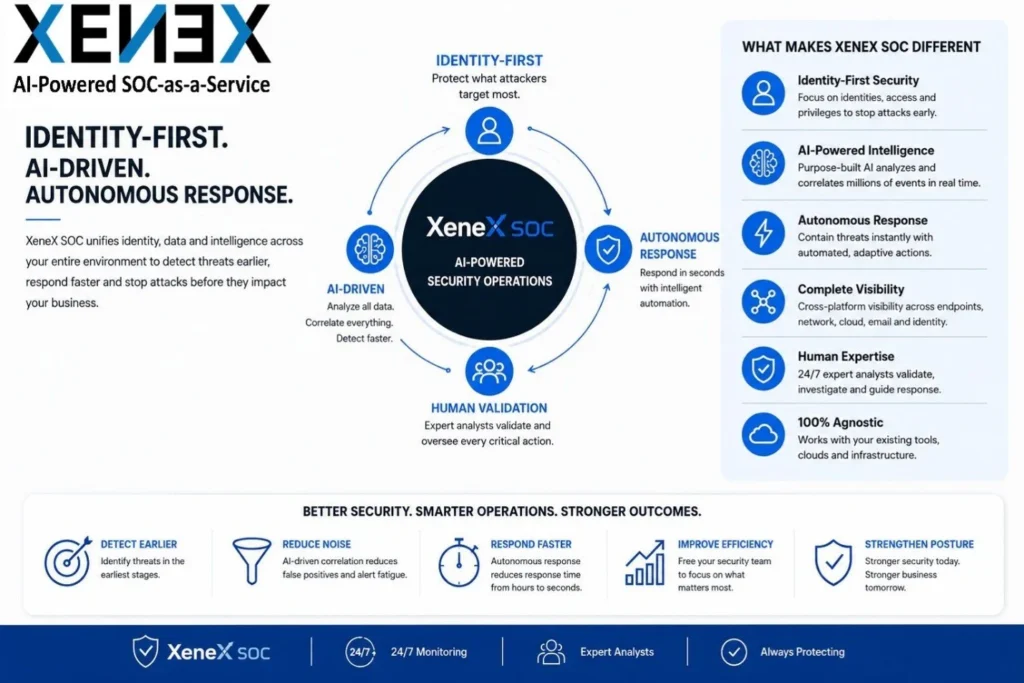
This kind of cross-environment correlation is exactly what XeneX’s AI was purpose-built to deliver — not bolted onto an existing product as a marketing afterthought, but engineered from the ground up specifically for the complexity and velocity of modern security operations. By ingesting and correlating telemetry from identity systems, endpoints, network traffic, cloud workloads, email security, and threat intelligence simultaneously, XeneX surfaces the full attack chain — not just individual events — giving analysts the context they need to act decisively and quickly.
Speed Is the Difference Between Containment and Catastrophe
Even with superior detection, speed of response remains one of the most critical variables in determining how damaging a breach ultimately becomes. Manual investigation cycles — even efficient ones — give attackers time. Time to move laterally. Time to establish persistence. Time to elevate access to the point where containment becomes genuinely costly and disruptive.
Platforms that can automatically disable compromised accounts, isolate endpoints, block malicious sessions, and trigger MFA challenges in seconds — not minutes or hours — fundamentally change the equation for attackers. When the window between intrusion and containment collapses, so does the attacker’s ability to cause lasting harm. Autonomous response doesn’t replace human judgment; it compresses the window of exposure while your analysts focus on validation, deeper investigation, and the strategic decisions that require real expertise and business context.
At XeneX, that balance between autonomous action and human oversight isn’t a feature — it’s a philosophy. The platform acts with speed, but every significant action is reviewed, validated, and explained by the dedicated concierge team assigned to your environment. You get machine-speed response with human-grade accountability.
Identity-First Security Isn’t Just a Strategy — It’s a Necessity
The organizations winning this fight aren’t necessarily the ones with the biggest security budgets. They’re the ones that have accepted a simple but profound truth: in a world of hybrid infrastructure, remote workforces, cloud applications, and SaaS sprawl, identity is the thread that connects everything. Every user, every device, every application, every system — they all interact through identities. If you’re not treating identity as your primary security perimeter, you’re defending the wrong frontier.
Protecting identity requires more than monitoring. It requires continuous, correlated intelligence across every telemetry source in your environment — paired with the speed, expertise, and structure to act before damage spreads. It also requires a partner who doesn’t just respond to incidents but actively works to mature your security posture over time, closing gaps before attackers find them and measuring progress in ways your board and leadership team can understand and act on.
Getting Ahead Is the Only Position That Counts
Security will always be a moving target. Attackers adapt, tools evolve, and the attack surface keeps expanding with every new cloud service, remote employee, and third-party integration your business adds. Staying reactive is no longer a viable strategy — the math simply doesn’t work in your favor.
But organizations that build their security strategy around identity-first principles, AI-driven cross-correlation, and autonomous response with human validation aren’t just keeping up — they’re getting ahead. They’re detecting threats earlier in the attack lifecycle, containing incidents before they become breaches, and continuously improving their security maturity in measurable, provable ways.
XeneX was built for exactly that reality. For the organizations that understand that modern threats require modern security operations — and that in cybersecurity, getting ahead isn’t just an advantage. It’s the only position that truly counts.
Identity SecurityCybersecurity Threat DetectionAI-Powered SOCManaged Security OperationsZero Trust SecurityCyber Incident Response
If you’ve ever been in a cybersecurity or IT discussion and heard terms like MSP, MSSP, SOC, MDR, XDR, SIEM, or SOCaaS used interchangeably, you’re not alone. The problem is that these models are often grouped together, even though they represent very different levels of cybersecurity capability.
As threats become faster, more automated, and more targeted, those differences matter more than ever. Modern cybersecurity is no longer just about keeping systems online—it’s about actively defending identities, cloud environments, SaaS platforms, and users in real time.
What Is an MSP?
A Managed Service Provider (MSP) focuses on keeping IT systems operational. They manage infrastructure, endpoints, Microsoft 365, cloud environments, backups, patching, networking, and help desk support.
While MSPs often provide basic security tools like antivirus or firewall management, they are not designed to function as cybersecurity defense organizations.
Most MSPs lack 24/7 threat monitoring, dedicated security analysts, real-time incident response, and advanced threat intelligence. As a result, they are essential for IT operations but limited in their ability to defend against modern cyberattacks.
What Is an MSSP?
A Managed Security Service Provider (MSSP) focuses specifically on security tools and monitoring. They deploy and manage technologies such as endpoint protection, email security, firewalls, vulnerability scanners, and compliance systems.
However, MSSPs often operate in a tool-driven and alert-based model. They generate alerts, but investigation and response are frequently left to the customer.
This creates a gap between detection and action. In complex environments with cloud, SaaS, and hybrid infrastructure, this often leads to fragmented visibility, alert fatigue, and slower response times.
In simple terms, MSSPs help manage security tools—but they do not always operate full cybersecurity defense functions.
What Is a SOCaaS Provider?
A Security Operations Center as a Service (SOCaaS) provider operates at a more advanced level. Instead of just managing tools or generating alerts, SOCaaS delivers full cybersecurity operations as a continuous service.
SOCaaS combines 24/7 monitoring, threat intelligence, automated correlation, incident investigation, and real-time response into a unified model. It continuously analyzes activity across endpoints, cloud environments, identities, SaaS applications, email, and networks to identify real threats in context.
Unlike MSSPs, SOCaaS providers are responsible for detecting, validating, investigating, and responding to threats. This makes them operationally accountable for cybersecurity outcomes, not just visibility.
In simple terms:
- MSPs keep systems running.
- MSSPs manage security tools.
- SOCaaS providers actively defend the environment in real time.
Why Traditional Models Are Struggling
Cybersecurity has evolved faster than traditional IT and security models. Attackers now use automation, AI, ransomware-as-a-service, phishing, credential theft, and supply chain attacks to scale their impact. At the same time, organizations have become more complex, with hybrid cloud environments, SaaS adoption, and remote workforces expanding the attack surface.
Most organizations now rely on dozens of disconnected tools, creating fragmented visibility and too many alerts without enough context. This leads to slower response times, operational inefficiency, and increased risk. The cybersecurity workforce shortage makes this worse, with millions of unfilled roles globally. At the same time, IBM reports the average cost of a data breach is now nearly $4.88 million, making speed of detection and response critical.
For many organizations, building a 24/7 internal SOC is no longer realistic.
Why SOCaaS Is Growing
SOCaaS addresses these challenges by delivering enterprise-grade security operations as a managed service. Instead of building a SOC internally, organizations gain continuous monitoring, AI-driven detection, threat intelligence, 24/7 analyst support, incident response, and compliance capabilities in a single model.
This reduces complexity, improves scalability, and replaces fragmented security tools with coordinated security operations.
How XeneX SOCaaS Approaches This Differently
At XeneX SOC, we believe security should be unified, not fragmented. Our SOCaaS model combines AI-powered threat detection, autonomous correlation, 24/7 analyst validation, real-time visibility, threat intelligence enrichment, vulnerability management, compliance support, and transparent reporting.
Instead of operating in silos, we correlate telemetry across the entire environment—helping organizations see threats that would otherwise remain hidden. The result is faster detection, less noise, and clearer security decisions.
Conclusion
The difference between MSPs, MSSPs, and SOCaaS providers comes down to one question: are you managing technology, or actively defending the business?
MSPs keep systems running. MSSPs manage security tools. SOCaaS delivers continuous, real-time cybersecurity operations that detect, investigate, and respond to threats across the entire environment. As attacks grow more sophisticated, organizations need more than tools. They need integrated security operations that can keep up with modern threats.
The future of cybersecurity is not more tools. It’s real-time, unified defense. Contact us to schedule a demo.
MSP vs MSSPSOCaaS cybersecuritymanaged security servicessecurity operations centercybersecurity models explainedSOC vs MSSP vs MSP
Adversary-in-the-Middle (AiTM) phishing attacks bypass MFA by capturing authenticated session cookies after a user successfully completes multi-factor authentication. The attacker replays the stolen token to access Microsoft 365 without ever needing the MFA code themselves.
I’ve spent years in the cybersecurity space, and I’ll be honest, there was a time when I felt confident telling clients that enforcing Multi-Factor Authentication was the single most impactful step they could take to protect their Microsoft 365 environments. That advice wasn’t wrong then. But the threat landscape has shifted beneath our feet, and I think it’s time we have a candid conversation about what’s actually happening out there.
What is an AiTM phishing attack?
An Adversary-in-the-Middle (AiTM) attack deploys a live reverse proxy between the victim and the real Microsoft 365 login page. The user goes through the entire authentication process, password, MFA prompt, the works, and genuinely believes they’ve signed in securely. What they don’t know is that every step passed through an attacker’s server, which silently captured the authenticated session cookie the moment Microsoft issued it. The attacker then replays that cookie to log in as the victim. No MFA required.
How AiTM session hijacking works step by step
- User receives a convincing phishing email with a malicious link.
- The link routes through an attacker-controlled reverse proxy that mirrors the real Microsoft 365 login page.
- User enters credentials and completes MFA legitimately.
- Microsoft issues an authenticated session cookie. The proxy intercepts it in real time.
- Attacker replays the stolen cookie to access the account no MFA prompt triggered.

Why traditional security tools miss these attacks
What frustrates me professionally is how poorly equipped most traditional security stacks are to catch this. These attacks frequently use valid HTTPS certificates, mirror legitimate Microsoft branding, and generate activity that looks entirely normal to legacy SIEM tools. The authentication was legitimate it was just intercepted. Basic email filtering doesn’t block a real-looking proxy page. Standard MFA enforcement doesn’t help once the session cookie has already been issued. Proofpoint’s 2025 research identified eleven distinct AiTM phishing kits actively targeting Microsoft 365 and Google accounts globally platforms like Tycoon 2FA that are sold as subscription services on Telegram, requiring minimal technical skill to deploy.
What happens after a Microsoft 365 account is compromised via AiTM?
Once attackers hold a valid session cookie, they gain persistent access to Exchange Online, SharePoint, OneDrive, and connected SaaS applications. Common follow-on activity includes internal phishing campaigns, Business Email Compromise (BEC), bulk data exfiltration, creation of new OAuth apps for persistent access, and in the most severe cases, ransomware deployment.
What actually stops an AiTM attack
Catching these attacks requires correlating signals that no single tool sees in isolation. A login from an unusual geography, paired with a mailbox rule created seconds later, combined with an OAuth application the user has never authorized, combined with a bulk SharePoint download at 2 AM — none of those events alone trips an alarm. Together, they paint a clear picture of compromise.
At XeneX SOC, the platform I operate on was built precisely for this threat environment. Rather than relying on isolated alerts, it continuously correlates identity telemetry, endpoint behavior, email events, network anomalies, and cloud authentication patterns in real time. When a compromised session surfaces — even after a valid MFA completion behavioral indicators like impossible travel, abnormal token reuse, or unauthorized OAuth activity can trigger automated response within seconds: account suspension, active session revocation, administrator notification, all while a human analyst validates the finding to minimize disruption.
The bottom line: identity is the new perimeter
The uncomfortable truth I share with every CISO I meet is this MFA is necessary, but it is no longer sufficient. Attackers have moved from breaking in to logging in, using stolen sessions and trusted identities rather than malware. Microsoft’s own research confirms this shift is accelerating. The organizations that weather this threat will be those investing in continuous behavioral monitoring and AI-driven cross-correlation, not those checking the MFA box and moving on. The adversaries have already adapted. It’s time our defenses do too.