
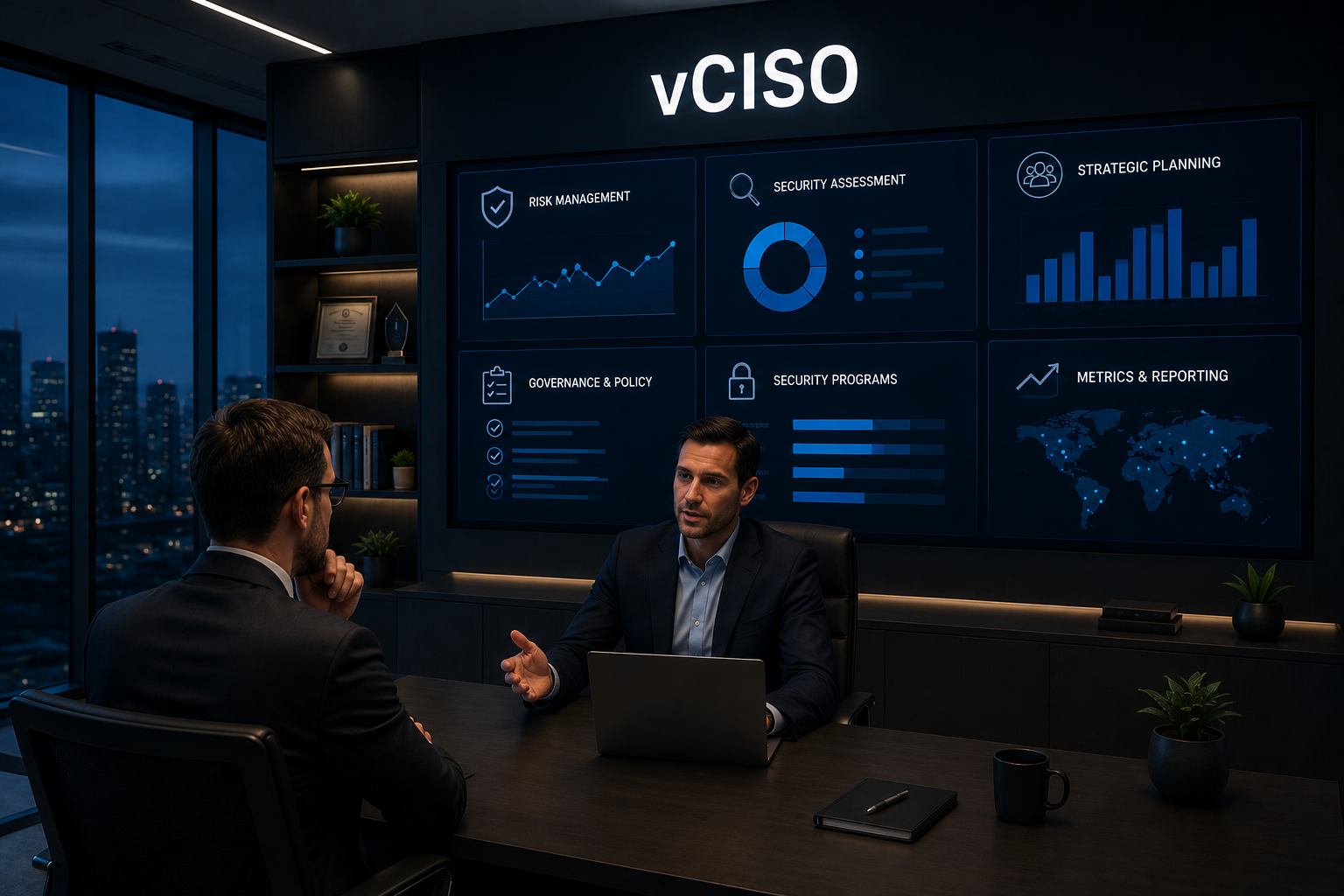
The Xenex vCISO Program delivers flexible and effective security leadership to your organization. XeneX senior cyber-security consultants work with your internal team to lead, develop and manage your most important security initiatives.
vCISO is available to complement an existing CISO and team, or as a flexible security department serving your organization.
XeneX vCISO (Virtual Chief Information Security Officer) service can be an efficient and cost-effective way for companies to bolster their cybersecurity posture, ensure compliance with regulations, and protect their digital assets without the commitment and expense associated with hiring a full-time CISO.
Customers choose XeneX vCISO services for several compelling reasons, depending on its unique circumstances and needs. Here are some of the key reasons why a company might opt for a vCISO service:
Hiring a full-time CISO can be expensive, and it may not be justifiable for smaller or medium-sized businesses with limited budgets. XeneX vCISO service provides access to experienced cybersecurity professionals at a fraction of the cost of a full-time employee.
XeneX vCISOs can be engaged on a part-time, temporary, or as-needed basis. This flexibility allows companies to scale their cybersecurity leadership according to their evolving requirements. For example, they can increase support during critical projects or reduce it during periods of lower demand.
XeneX’s experienced vCISOs can quickly assess an organization's cybersecurity posture and implement necessary improvements without the time it takes to hire and onboard a new employee. This can be crucial for addressing pressing security concerns promptly.
XeneX’s vCISOs often have experience across various industries and can provide specialized knowledge tailored to a company's specific sector and challenges. This industry-specific expertise can be particularly valuable in addressing sector-specific regulations and threats.
As external consultants, XeneX vCISOs offer an objective viewpoint of the organization's cybersecurity posture. They are not influenced by internal politics or biases that may exist in a full-time, in-house role, which can lead to more unbiased decision-making.
XeneX vCISOs are skilled in identifying and managing cybersecurity risks effectively. They can help companies prioritize vulnerabilities and develop risk mitigation strategies to reduce the likelihood and impact of security breaches.
XeneX vCISOs are well-versed in compliance requirements and can ensure that the company meets the necessary cybersecurity regulations and standards. This reduces the risk of legal and regulatory penalties.
Companies can easily adjust the level of XeneX vCISO support as their needs change due to factors like growth, changes in the threat landscape, or specific projects. This adaptability ensures that security efforts remain aligned with the organization's current requirements.
XeneX vCISOs can help companies optimize their cybersecurity budgets by identifying cost-effective solutions and prioritizing security investments based on risk. This can lead to more efficient resource allocation.
Many XeneX vCISOs have extensive networks within the cybersecurity community, including contacts with other experts, vendors, and service providers. This network can be valuable for sourcing resources and information.
By outsourcing the cybersecurity leadership role to a XeneX vCISO, companies can concentrate on their core competencies and leave security management to experts who can handle it effectively.
XeneX vCISOs provide continuity in cybersecurity leadership, ensuring that the company's security efforts do not falter due to turnover or extended absences.
XeneX vCISOs can implement security awareness training programs to educate employees about cybersecurity best practices, reducing the risk of human error-related security incidents.
Establishing a cybersecurity governance framework is a crucial responsibility of a XeneX vCISO, ensuring accountability and oversight in the organization's security efforts.
vCISOs are often hired because of their expertise and experience, allowing organizations to benefit from their knowledge without the need for a full-time CISO. Their responsibilities can vary depending on the specific needs of the organization and the terms of the engagement.
With a strong track record and experience relevant to their industry and specific needs, XeneX vCISOs offer many advantages. Here are the key responsibilities of a XeneX vCISO:
Develop and implement a strategic cybersecurity vision and roadmap aligned with the organization's business goals and objectives.
Identify, assess, and prioritize cybersecurity risks and vulnerabilities. Develop and execute risk mitigation strategies to protect the organization's information assets.
Develop, review, and enforce information security policies, standards, and procedures to ensure compliance with industry regulations and best practices.
Design and oversee security awareness and training programs for employees, ensuring that all staff members are informed and educated about cybersecurity best practices.
Define and maintain the organization's security architecture, including network security, infrastructure security, and application security.
Develop an incident response plan and lead efforts to respond to and recover from security incidents and breaches effectively. This may involve coordinating with external incident response teams.
Assess and manage the security risks associated with third-party vendors and service providers. Ensure that third-party contracts include appropriate security provisions.
Ensure the organization complies with relevant cybersecurity laws, regulations, and industry standards (e.g., GDPR, HIPAA, ISO 27001).
Conduct regular security audits, risk assessments, and penetration testing to identify vulnerabilities and ensure ongoing security.
Evaluate and recommend security technologies, tools, and solutions to enhance the organization's security posture.
Manage the cybersecurity budget, ensuring that resources are allocated efficiently to address security needs effectively.
Serve as the point of contact for communicating with executive leadership, stakeholders, customers, and regulatory authorities in the event of a security incident.
Define and track key performance indicators (KPIs) and metrics to measure the effectiveness of the cybersecurity program. Provide regular reports to executive management and the board of directors.
If the organization has an internal cybersecurity team, the vCISO may be responsible for hiring, training, and managing security personnel.
Establish and chair a cybersecurity governance committee or working group to ensure ongoing oversight and accountability.
Foster a culture of cybersecurity awareness and responsibility throughout the organization.
Stay current with emerging cybersecurity threats and trends and adjust the cybersecurity strategy and tactics accordingly.
Maintain awareness of legal and regulatory changes related to cybersecurity and ensure that the organization remains compliant.
Collaborate on business continuity and disaster recovery planning to ensure the organization's ability to recover from disruptions.
Present cybersecurity updates and recommendations to the board of directors to ensure they are informed and engaged in cybersecurity governance.
XeneX XDR+, or Extended Detection and Response, is an advanced cybersecurity solution that improves threat detection, investigation, and response across an organization's entire digital environment. Unlike traditional endpoint detection and response tools, XeneX XDR+ expands its scope to include network traffic, cloud services, email, and other data sources, providing a more unified and comprehensive approach to security.
By combining data from diverse sources and applying advanced analytics, XeneX XDR+ gives organizations better visibility into their security posture, faster threat detection, and more effective incident response than conventional solutions.
XeneX XDR continuously monitors data across endpoints, servers, networks, and cloud environments to detect a wide range of threats, including unauthorized access, lateral movement, data exfiltration, and multi-stage attacks. Its advanced analytics, machine learning, and behavioral analysis identify suspicious patterns that may indicate sophisticated or evolving threats.
In addition to automated detection, XeneX XDR+ supports proactive threat hunting, allowing security analysts to search for hidden or emerging threats that may not have triggered automated alerts.
When XeneX XDR+ identifies a potential threat, it can initiate automated responses based on predefined rules. These actions may include isolating compromised systems, blocking malicious processes, and generating alerts for your security team to review and act on immediately.
Security analysts also have access to investigation tools such as timeline views, root cause analysis, and contextual information to help them fully understand the scope of an attack and coordinate an effective response as quickly as possible.
XeneX XDR+ delivers a wide range of security benefits, including comprehensive threat visibility across all platforms, early threat detection through behavioral analysis, reduced false positives, faster incident response, and centralized management through a unified dashboard. It also helps organizations meet regulatory compliance requirements by ensuring proper data protection measures are in place.
Beyond detection, XeneX XDR+ contributes to long-term security resilience by providing threat intelligence and trend analysis, helping organizations understand emerging attack patterns and adapt their defenses accordingly.
Yes. XeneX XDR+ is designed to integrate with other cybersecurity platforms and tools, including SIEM systems, EDR solutions, and threat intelligence platforms. This integration enhances your organization's overall security ecosystem rather than requiring a replacement of existing investments.
The platform is also scalable to accommodate organizations of different sizes and industries, making it a cost-effective alternative to building and maintaining separate solutions for endpoint, network, and cloud security.
