

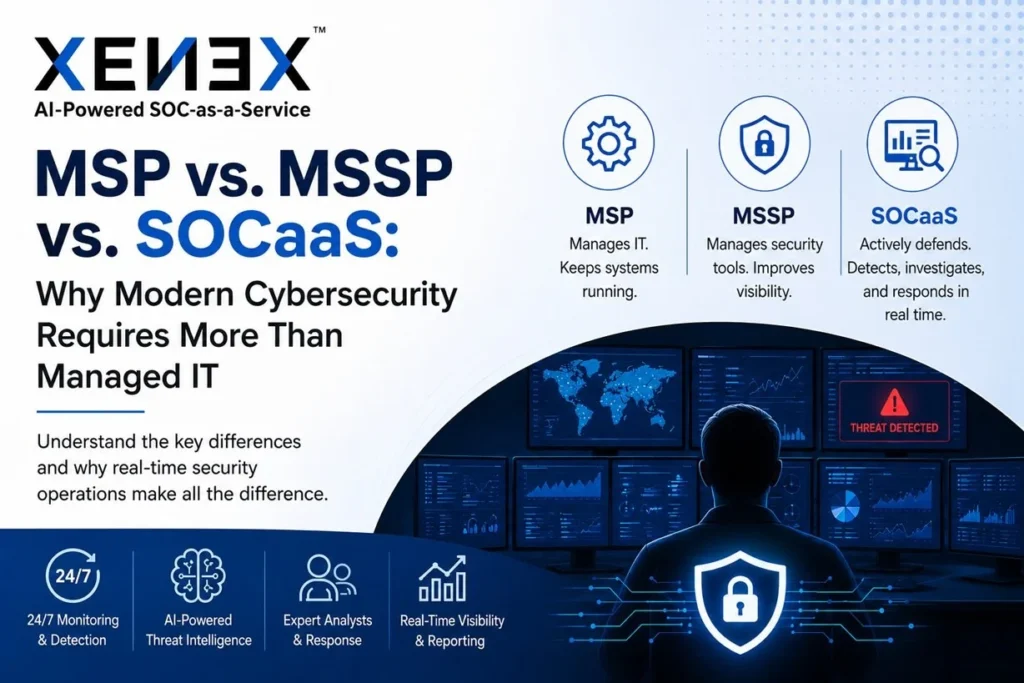
If you’ve ever been in a cybersecurity or IT discussion and heard terms like MSP, MSSP, SOC, MDR, XDR, SIEM, or SOCaaS used interchangeably, you’re not alone. The problem is that these models are often grouped together, even though they represent very different levels of cybersecurity capability.
As threats become faster, more automated, and more targeted, those differences matter more than ever. Modern cybersecurity is no longer just about keeping systems online—it’s about actively defending identities, cloud environments, SaaS platforms, and users in real time.
What Is an MSP?
A Managed Service Provider (MSP) focuses on keeping IT systems operational. They manage infrastructure, endpoints, Microsoft 365, cloud environments, backups, patching, networking, and help desk support.
While MSPs often provide basic security tools like antivirus or firewall management, they are not designed to function as cybersecurity defense organizations.
Most MSPs lack 24/7 threat monitoring, dedicated security analysts, real-time incident response, and advanced threat intelligence. As a result, they are essential for IT operations but limited in their ability to defend against modern cyberattacks.
What Is an MSSP?
A Managed Security Service Provider (MSSP) focuses specifically on security tools and monitoring. They deploy and manage technologies such as endpoint protection, email security, firewalls, vulnerability scanners, and compliance systems.
However, MSSPs often operate in a tool-driven and alert-based model. They generate alerts, but investigation and response are frequently left to the customer.
This creates a gap between detection and action. In complex environments with cloud, SaaS, and hybrid infrastructure, this often leads to fragmented visibility, alert fatigue, and slower response times.
In simple terms, MSSPs help manage security tools—but they do not always operate full cybersecurity defense functions.
What Is a SOCaaS Provider?
A Security Operations Center as a Service (SOCaaS) provider operates at a more advanced level. Instead of just managing tools or generating alerts, SOCaaS delivers full cybersecurity operations as a continuous service.
SOCaaS combines 24/7 monitoring, threat intelligence, automated correlation, incident investigation, and real-time response into a unified model. It continuously analyzes activity across endpoints, cloud environments, identities, SaaS applications, email, and networks to identify real threats in context.
Unlike MSSPs, SOCaaS providers are responsible for detecting, validating, investigating, and responding to threats. This makes them operationally accountable for cybersecurity outcomes, not just visibility.
In simple terms:
- MSPs keep systems running.
- MSSPs manage security tools.
- SOCaaS providers actively defend the environment in real time.
Why Traditional Models Are Struggling
Cybersecurity has evolved faster than traditional IT and security models. Attackers now use automation, AI, ransomware-as-a-service, phishing, credential theft, and supply chain attacks to scale their impact. At the same time, organizations have become more complex, with hybrid cloud environments, SaaS adoption, and remote workforces expanding the attack surface.
Most organizations now rely on dozens of disconnected tools, creating fragmented visibility and too many alerts without enough context. This leads to slower response times, operational inefficiency, and increased risk. The cybersecurity workforce shortage makes this worse, with millions of unfilled roles globally. At the same time, IBM reports the average cost of a data breach is now nearly $4.88 million, making speed of detection and response critical.
For many organizations, building a 24/7 internal SOC is no longer realistic.
Why SOCaaS Is Growing
SOCaaS addresses these challenges by delivering enterprise-grade security operations as a managed service. Instead of building a SOC internally, organizations gain continuous monitoring, AI-driven detection, threat intelligence, 24/7 analyst support, incident response, and compliance capabilities in a single model.
This reduces complexity, improves scalability, and replaces fragmented security tools with coordinated security operations.
How XeneX SOCaaS Approaches This Differently
At XeneX SOC, we believe security should be unified, not fragmented. Our SOCaaS model combines AI-powered threat detection, autonomous correlation, 24/7 analyst validation, real-time visibility, threat intelligence enrichment, vulnerability management, compliance support, and transparent reporting.
Instead of operating in silos, we correlate telemetry across the entire environment—helping organizations see threats that would otherwise remain hidden. The result is faster detection, less noise, and clearer security decisions.
Conclusion
The difference between MSPs, MSSPs, and SOCaaS providers comes down to one question: are you managing technology, or actively defending the business?
MSPs keep systems running. MSSPs manage security tools. SOCaaS delivers continuous, real-time cybersecurity operations that detect, investigate, and respond to threats across the entire environment. As attacks grow more sophisticated, organizations need more than tools. They need integrated security operations that can keep up with modern threats.
The future of cybersecurity is not more tools. It’s real-time, unified defense. Contact us to schedule a demo.
MSP vs MSSPSOCaaS cybersecuritymanaged security servicessecurity operations centercybersecurity models explainedSOC vs MSSP vs MSP
Adversary-in-the-Middle (AiTM) phishing attacks bypass MFA by capturing authenticated session cookies after a user successfully completes multi-factor authentication. The attacker replays the stolen token to access Microsoft 365 without ever needing the MFA code themselves.
I’ve spent years in the cybersecurity space, and I’ll be honest, there was a time when I felt confident telling clients that enforcing Multi-Factor Authentication was the single most impactful step they could take to protect their Microsoft 365 environments. That advice wasn’t wrong then. But the threat landscape has shifted beneath our feet, and I think it’s time we have a candid conversation about what’s actually happening out there.
What is an AiTM phishing attack?
An Adversary-in-the-Middle (AiTM) attack deploys a live reverse proxy between the victim and the real Microsoft 365 login page. The user goes through the entire authentication process, password, MFA prompt, the works, and genuinely believes they’ve signed in securely. What they don’t know is that every step passed through an attacker’s server, which silently captured the authenticated session cookie the moment Microsoft issued it. The attacker then replays that cookie to log in as the victim. No MFA required.
How AiTM session hijacking works step by step
- User receives a convincing phishing email with a malicious link.
- The link routes through an attacker-controlled reverse proxy that mirrors the real Microsoft 365 login page.
- User enters credentials and completes MFA legitimately.
- Microsoft issues an authenticated session cookie. The proxy intercepts it in real time.
- Attacker replays the stolen cookie to access the account no MFA prompt triggered.

Why traditional security tools miss these attacks
What frustrates me professionally is how poorly equipped most traditional security stacks are to catch this. These attacks frequently use valid HTTPS certificates, mirror legitimate Microsoft branding, and generate activity that looks entirely normal to legacy SIEM tools. The authentication was legitimate it was just intercepted. Basic email filtering doesn’t block a real-looking proxy page. Standard MFA enforcement doesn’t help once the session cookie has already been issued. Proofpoint’s 2025 research identified eleven distinct AiTM phishing kits actively targeting Microsoft 365 and Google accounts globally platforms like Tycoon 2FA that are sold as subscription services on Telegram, requiring minimal technical skill to deploy.
What happens after a Microsoft 365 account is compromised via AiTM?
Once attackers hold a valid session cookie, they gain persistent access to Exchange Online, SharePoint, OneDrive, and connected SaaS applications. Common follow-on activity includes internal phishing campaigns, Business Email Compromise (BEC), bulk data exfiltration, creation of new OAuth apps for persistent access, and in the most severe cases, ransomware deployment.
What actually stops an AiTM attack
Catching these attacks requires correlating signals that no single tool sees in isolation. A login from an unusual geography, paired with a mailbox rule created seconds later, combined with an OAuth application the user has never authorized, combined with a bulk SharePoint download at 2 AM — none of those events alone trips an alarm. Together, they paint a clear picture of compromise.
At XeneX SOC, the platform I operate on was built precisely for this threat environment. Rather than relying on isolated alerts, it continuously correlates identity telemetry, endpoint behavior, email events, network anomalies, and cloud authentication patterns in real time. When a compromised session surfaces — even after a valid MFA completion behavioral indicators like impossible travel, abnormal token reuse, or unauthorized OAuth activity can trigger automated response within seconds: account suspension, active session revocation, administrator notification, all while a human analyst validates the finding to minimize disruption.
The bottom line: identity is the new perimeter
The uncomfortable truth I share with every CISO I meet is this MFA is necessary, but it is no longer sufficient. Attackers have moved from breaking in to logging in, using stolen sessions and trusted identities rather than malware. Microsoft’s own research confirms this shift is accelerating. The organizations that weather this threat will be those investing in continuous behavioral monitoring and AI-driven cross-correlation, not those checking the MFA box and moving on. The adversaries have already adapted. It’s time our defenses do too.